
Over the past two decades, manufacturing has moved through several waves of digitalization: first the automation of individual processes, then the interconnection of data across the shop floor (ERP, MES, SCADA, PLC), and more recently the arrival of artificial intelligence in decision-making. Today a new phase is opening — perhaps the most ambitious one yet: teaching artificial intelligence to move and act in the physical world. This is what's known as Physical AI, and the ground on which it is trained is not the real factory, but its digital counterpart.
To understand where this is heading, it helps to start from where we are: with two technologies that are often confused with one another, but that actually address different, complementary needs.
Digital Twin and Virtual Commissioning are not the same thing
The term "digital twin" is used quite loosely these days, often as a synonym for any 3D model of a machine. The actual definition is more precise: an industrial digital twin is a digital replica of a machine or plant that is continuously fed with real data from the field. What sets it apart is not the geometric accuracy of the model, but its ability to evolve over time alongside the physical system it represents — tracking wear, maintenance cycles and process variations, and returning increasingly accurate predictions as it accumulates data.
Virtual commissioning is a narrower — and, in a sense, earlier — concept: it refers to the phase in which control software, typically PLC code, is tested on a virtual model of the machine before the machine is physically built. The goal is to verify that the automation logic works correctly, that there are no mechanical interferences, and that cycle times match expectations, all without having to stop a real production line or wait for a physical prototype to become available.
The relationship between the two is therefore sequential rather than alternative: virtual commissioning is often the entry point — the phase in which the machine's virtual model is born — while the digital twin is what that same model can become if, instead of being archived after testing, it continues to be fed with real data throughout the asset's operational life.
Why manufacturing companies are investing in this direction
The reasons aren't purely technological. The competitive environment manufacturers operate in today — cost pressure, a shortage of skilled labour, the need to shorten time-to-market — makes it hard to ignore tools that let you catch errors before they become costs.
A few concrete examples, drawn from experience with real machines and production lines:
- During development, being able to validate control software on a virtual model — rather than on the real machine, which is often only available in the final weeks before delivery — makes it possible to catch and fix design errors while they're still cheap to fix, before production has even started.
- During the sales process, an accurate virtual model lets you show a customer how a machine or an entire line will behave before it physically exists: especially useful for processes that are invisible to the naked eye, too fast to observe, or for plants too large to make a live demo practical.
- During operation, that same model — if kept alive as a digital twin — becomes the basis for training operators in a safe environment, for simulating maintenance work before performing it on the real machine, and, by integrating IoT data and AI algorithms, for predicting failures before they occur.
The common thread is always the same: pushing the moment a problem is discovered as far upstream as possible in the process, where it costs the least to fix.
Where this technology is applied today
Looking at industrial practice, the most established application areas can be grouped into four broad categories:
- Automation software development, where the machine's virtual model is used to test the PLC logic before physical commissioning;
- Technical training, where the digital twin becomes a simulator for training operators and maintenance technicians on machine-side operations, without the risks and downtime costs tied to training on the real plant;
- Operational optimization, where the plant's digital twin supports the ongoing analysis and improvement of production flows, internal logistics and asset management;
- Training of advanced automation systems, a more recent area that includes autonomous guided vehicles (AGVs) and, increasingly, humanoid robots.
It is this last area that is drawing the most attention from the industry right now — and where the digital twin is finding a new reason for being.
The next frontier: training physical AI in the virtual world
Until recently, AI applied to industry operated mainly on data — forecasting, optimization, classification. Physical AI shifts the field of action: these are systems that must learn to perceive physical space, move through it, and interact with objects and people safely and in a coordinated way. This is the case for humanoid robots destined for production lines, and for the intelligent orchestrators tasked with managing an entire plant's operation in real time.
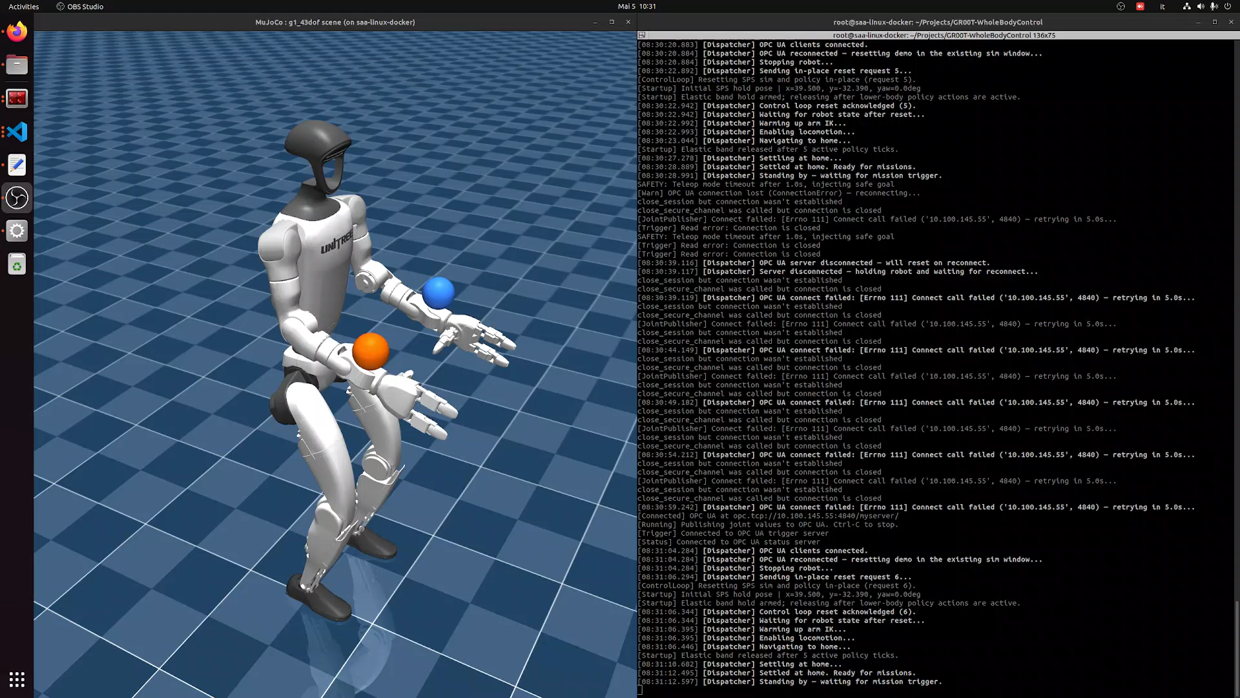
The problem with this kind of system is that training directly in the field is risky, slow and expensive: a robot that gets a movement wrong in a real factory can damage equipment or, worse, put a worker at risk. The digital twin solves this problem by moving training into a physics-accurate virtual environment, where it becomes possible to:
- have a humanoid robot go through thousands of operational scenarios — including unexpected or emergency situations — with no risk to people or equipment, before it ever sets foot on the factory floor;
- train an AI-powered orchestrator to monitor the state of the production system, simulate alternative scenarios and optimize flows and assets, then connect it to the real plant once its behaviour has been validated in the virtual environment.
In both cases, the digital twin is no longer just a testing or analysis tool: it becomes the training ground where artificial intelligence gains the experience it needs to operate safely in the physical world. It's a significant shift in perspective — from a model that replicates the machine, to a model that trains whoever (or whatever) will run it.
A look at the near future
The implications of this trajectory go beyond any single technology. If the digital twin becomes the place where Physical AI is trained, the quality and reliability of the virtual model stop being a technical detail and become an enabling condition for the safe adoption of advanced robotics and autonomous automation on the factory floor. Companies investing today in building accurate, continuously maintained digital twins aren't just optimizing their current processes — they're building the infrastructure the next generation of industrial automation will run on.
Digital twin & virtual
commissioning
We develop digital twins of plants and equipment, accelerating design, testing, validation, and industrial commissioning.
